


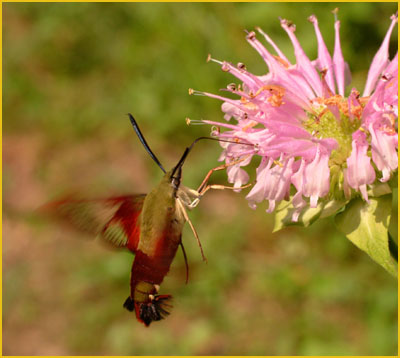
How-To: Other Pollinators
More than 300 species of hummingbirds live in North, Central and South America. When a hummingbird extends its very long tongue deep into a flower to drink its nectar, pollen sticks to the hummingbird's beak and head. Some of the pollen grains drop off when it visits other flowers, pollinating them.
Celebrating Wildflowers: Animal Pollination
http://www.fs.fed.us/wildflowers/pollinators/animals/index.shtml
From the U.S. Forest Service
Animal pollinators play a crucial role in flowering plant reproduction and in the production of most fruits and vegetables. Most plants require the assistance of pollinators to produce seeds and fruit. About 80% of all flowering plants and over three-quarters of the staple crop plants that feed humankind rely on animal pollinators.
Celebrating Wildflowers: Bat Pollination
http://www.fs.fed.us/wildflowers/pollinators/animals/bats.shtml
From the U.S. Forest Service
After dark, moths and bats take over the pollinator night shift. Bats are very important pollinators in tropical and desert climates. Most flower-visiting bats are found in Africa, Southeast Asia, and the Pacific Islands. Two species of nectar-feeding bats, the lesser long-nosed bat and the Mexican long-tongued bat, migrate north a thousand miles or more every spring from Mexico into Arizona, New Mexico, and Texas. Both are listed as federally endangered species.